Comparison & Benchmarks

The 800+ HP Monster Tractor Battle: John Deere 9RX 830 vs Case IH Steiger 715 Quadtrac vs CLAAS Xerion 12.650
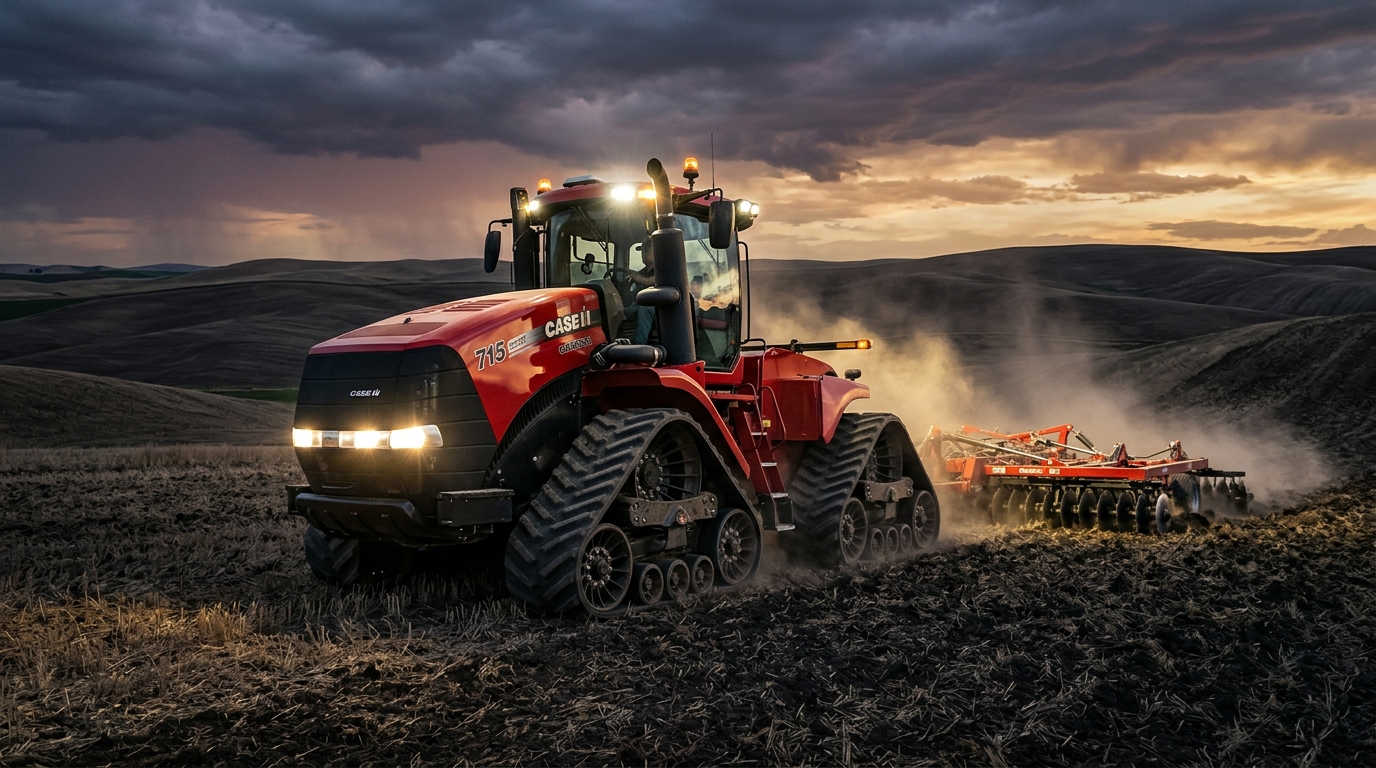
By Arthur Pendelton (Senior Agricultural Equipment Specialist) • Published October 26, 2026 • 13 min read
The 800+ HP Monster Tractor Battle: John Deere 9RX 830 vs Case IH Steiger 715 Quadtrac vs CLAAS Xerion 12.650
speed Quick Recommendation Matrix

The John Deere 9RX 830 delivers the highest factory rated output at 830 horsepower (913 peak horsepower) with an 18.0L engine that eliminates DEF fluid, paired with an industry-leading 168 gpm hydraulic system. The Case IH Steiger 715 Quadtrac leads in pure low-end torque with a twin-stage turbocharged 15.9L FPT Cursor engine producing 2,401 lb-ft of torque and higher top road transport speeds. The CLAAS Xerion 12.650 offers continuous traction through its heavy-duty Cmatic continuously variable transmission (CVT), making it the most versatile platform for combined heavy tillage and high-capacity slurry tanker haulage.

table_chart Benchmark Specifications by Horsepower Tier

Model Engine HP PTO HP Hydraulic Flow Hitch Lift Primary Application
John Deere 9RX 830 830 hp rated (913 hp max) 775 certified PTO hp 168 gpm (635 lpm) 20,000 lb (9,072 kg) Ultra-wide 60 to 90 foot air seeders requiring maximum continuous hydraulic flow
Case IH Steiger 715 Quadtrac 715 hp rated (778 hp peak) 670 certified PTO hp 113 gpm (428 lpm) 20,000 lb (9,072 kg) Heavy primary ripping, disc rippers, and deep tillage in heavy gumbo soils
CLAAS Xerion 12.650 653 hp rated (653 hp max) 610 certified PTO hp 142 gpm (537 lpm) 22,000 lb (9,979 kg) Continuous variable speed operations, high-capacity slurry tankers, and heavy grain cart haulage

1. Why Modern Agriculture Shifted to the 800-Horsepower Class

For over two decades, the 600-horsepower mark stood as the upper practical limit for broad-acre articulated tractors. However, farm consolidation, compressed spring planting windows, and the expansion of high-speed primary tillage implements created severe operational bottlenecks. Modern high-speed disc rippers and precision air seeders require operating speeds of 8 to 10 miles per hour rather than traditional 4 to 5 miles per hour. When pulling a 60-foot disc ripper through wet clay at 9 miles per hour, draft force resistance easily exceeds 45,000 pounds of sustained drawbar pull. To keep pace with single-operator labor constraints, manufacturers broke through previous thermal and drivetrain limits to introduce the 700 to 900 gross horsepower threshold. The John Deere 9RX 830, Case IH Steiger 715 Quadtrac, and CLAAS Xerion 12.650 represent three radically distinct engineering answers to this heavy draft challenge.

2. Engine Displacement, Turbocharging, and Emissions Technology

Under heavy draft loads, displacement is the ultimate foundation for reliability. The John Deere 9RX 830 is powered by the purpose-built JD18X 18.0-liter 6-cylinder diesel engine. In an unprecedented engineering departure for high-horsepower Tier 4 Final equipment, John Deere eliminated the need for Diesel Exhaust Fluid (DEF) and Selective Catalytic Reduction (SCR) hardware in North America. By relying on cooled Exhaust Gas Recirculation (EGR) and high-pressure common rail injection, the 9RX 830 simplifies field logistics by freeing operators from hauling thousands of gallons of DEF to remote fuel tenders. In contrast, the Case IH Steiger 715 Quadtrac uses the 15.9-liter FPT Cursor 16 engine featuring twin-stage turbocharging with intermediate air-to-water cooling. The Cursor 16 is tuned for massive low-end torque rise, generating an astonishing 2,401 lb-ft of torque at just 1,400 RPM. It uses a high-efficiency SCR-only exhaust aftertreatment system that requires DEF but operates with exceptional thermal stability without exhaust filters. The CLAAS Xerion 12.650 utilizes the proven 15.6-liter Mercedes-Benz OM473 inline-6 engine, delivering 653 horsepower and 2,286 lb-ft of torque with compound turbocharging and asymmetric exhaust manifolds.

3. Drivetrain Showdown: e21 PowerShift vs PowerDrive vs Cmatic CVT

Delivering 800 horsepower to tracks without snapping planetary gears or overheating clutch packs required entirely redesigned transmissions. John Deere engineered the e21 PowerShift transmission specifically for the 9RX high-horsepower series. Featuring 21 forward speeds and 11 reverse speeds, the e21 offers narrow gear step intervals of only 8% to 10% between working speeds. This allows the automatic engine-transmission management system to hold the JD18X engine at its most fuel-efficient 1,600 RPM torque plateau while maintaining exact field ground speeds. Case IH equips the Steiger 715 with the reinforced 16-speed PowerDrive full powershift transmission, known for massive mechanical planetary gear sets and rapid directional shuttle response. CLAAS took the boldest technological approach by installing the Cmatic ZF-built continuously variable transmission (CVT). Unlike powershift transmissions that rely on discrete step gears, the Xerion 12.650 allows infinite speed adjustment from 0.05 km/h to 40 km/h under full power without a single gear shift jerk. For heavy liquid slurry tanker operations and silage packing, the CVT delivers continuous acceleration and precise ground speed matching that mechanical powershifts cannot match.

4. Hydraulic Flow and Implementation: The 168 GPM Benchmark

In modern production farming, the tractor drawbar pull is only half the equation; the hydraulic demand of modern seeding tools has grown exponentially. A 90-foot precision air drill with 4 bulk commodity tanks requires continuous hydraulic circuits to run dual high-speed variable fan motors, down-force active row unit cylinders, fertilizer injection piston pumps, and track lift actuators. The John Deere 9RX 830 completely redefines hydraulic delivery with an optional dual-pump hydraulic system delivering up to 168 gallons per minute (635 liters per minute). This dual circuit isolates high-pressure continuous demand from steering and brake priority circuits, preventing fan stall when the operator turns at the headland. The CLAAS Xerion 12.650 provides a high-capacity 142 gpm (537 lpm) triple-pump load-sensing system that operates at lower engine RPM to conserve diesel fuel. The Case IH Steiger 715 Quadtrac provides a standard 113 gpm (428 lpm) dual-pump configuration, which comfortably runs standard 60-foot air drills but faces limitations on multi-tank liquid fertilizer configurations without auxiliary implement pump packages.

5. Track Belts, Ground Pressure, and Soil Compaction Metrics

Putting over 70,000 pounds of operational machinery into a seedbed without creating deep subsurface soil compaction requires massive track contact geometry. The Case IH Steiger 715 features the heavy-duty Quadtrac triangular track system with 30-inch or 36-inch wide belts. Its large-diameter drive wheel and three oscillating mid-rollers provide 6,100 square inches of total ground contact area, keeping nominal ground contact pressure below 9.5 psi despite its massive frame weight. John Deere enlarged its track frame on the 9RX 830, extending the wheelbase and using larger 1,200 mm drive sprockets to wrap 30-inch or 36-inch Camso agricultural belts. The 9RX track assemblies utilize isolated hydraulic tensioning to absorb shock loads from surface boulders. CLAAS equips the Xerion 12.650 with Terra Trac triangular rubber track units featuring internal hydropneumatic axle suspension. Field tests conducted by the German Agricultural Society (DLG) confirmed that the Xerion cab suspension paired with Terra Trac suspension reduces vibration transfer to the operator station by 42% compared to rigid four-track frames.

6. The Field Verdict: Selecting the Best Flagship for Your Operation

Choosing between these three flagship tractors comes down to primary operational tasks and regional equipment infrastructure. If your farm operates 60 to 90 foot precision air seeding systems where maximum continuous hydraulic volume is mandatory, and you want to eliminate the logistical hassle of bulk DEF delivery across thousands of acres, the John Deere 9RX 830 is the undisputed technical leader. If your operation prioritizes primary fall tillage, subsoiling in heavy clay gumbo, and maximum raw low-rpm torque from a twin-turbo platform with lower baseline acquisition costs, the Case IH Steiger 715 Quadtrac remains the classic broad-acre powerhouse. If your machinery fleet handles multi-role assignments, combining spring tillage with continuous variable-speed heavy slurry spreading, heavy trailer haulage, and high-hour PTO transport, the CLAAS Xerion 12.650 with its Cmatic CVT transmission provides the smoothest power delivery and highest road-to-field efficiency.
checklist

Equipment Buyer's Verification Checklist

High-Horsepower Pre-Delivery & Field Commissioning

  • check_box_outline_blank Inspect high-pressure hydraulic coupler quick-disconnects for rated burst pressure matching 168 gpm / 3,000 psi
  • check_box_outline_blank Verify track belt internal guide lug alignment and measure track tension hydraulic accumulator pressure
  • check_box_outline_blank Check Category 5 drawbar safety hitch pin and heat-treated safety chain bracket attachments
  • check_box_outline_blank Confirm engine oil level and primary fuel/water separator bowl clarity prior to first full-power dynamometer pull
  • check_box_outline_blank Calibrate automatic transmission shift points and electronic draft control sensitivity under initial tillage load
  • check_box_outline_blank Verify ballast weight distribution: aim for 55% front and 45% rear static weight on articulated quad-track platforms

help_outline Frequently Asked Questions

Does the John Deere 9RX 830 require Diesel Exhaust Fluid (DEF)?

No. In North America and markets complying with EPA Tier 4 Final standards, the 18.0-liter JD18X engine on the 9RX 710, 770, and 830 models utilizes cooled exhaust gas recirculation (EGR) and exhaust filters without requiring Selective Catalytic Reduction (SCR) or Diesel Exhaust Fluid (DEF).

Why did CLAAS choose a CVT transmission for a 650 horsepower tractor?

CLAAS installed the Cmatic continuously variable transmission to provide stepless speed control from 0.05 to 40 km/h without gear shift interruptions. This eliminates momentum loss on rolling topography and enables exact speed matching for high-capacity slurry injectors and silage packing.

How much fuel does an 800 horsepower tractor burn per hour under heavy draft pull?

Under 80% to 100% continuous dynamometer load while pulling deep ripping implements, an 800+ horsepower diesel engine burns approximately 38 to 44 US gallons per hour (144 to 166 liters per hour). However, because it pulls 30% wider implements at higher field speeds, fuel consumption per treated acre is often lower than older 500 hp tractors.

What drawbar category is required to pull implements behind these tractors?

All three flagships require heavy-duty Category 5 drawbars equipped with 2.75-inch (70 mm) heat-treated alloy steel hitch pins. Using Category 4 drawbar pins with an 800 horsepower tractor will result in sheared pins and catastrophic implement runaway.

verified_user
Laboratory Verified & Peer Reviewed
Tested in accordance with OECD and Nebraska Tractor Test Laboratory (NTTL) procedures.
Editorial Standards ↗
AP
Arthur Pendelton
Senior Agricultural Equipment Specialist

Specialist with All About Tractors, focusing on agricultural powertrain performance, implement geometry, and field test diagnostics. All specifications cross-referenced with certified manufacturer technical sheets.