Application Guide

Best Tractors for Haying and Baling: Minimum Horsepower for Round vs Square Balers
By Arthur Pendelton (Senior Agricultural Equipment Specialist) • Published November 26, 2026 • 13 min read
Best Tractors for Haying and Baling: Minimum Horsepower for Round vs Square Balers
speed Quick Recommendation Matrix

Operating a hay baler requires balancing certified PTO horsepower, flywheel momentum, hydraulic remote flow, and bare tractor chassis weight. For small square balers (14x18 inch bales), a minimum 35 to 45 PTO horsepower tractor weighing at least 3,500 pounds is required to absorb the forward-and-back rocking thrust of the plunger. For 4x4 and 4x5 round balers, a minimum 55 to 70 PTO horsepower tractor weighing 5,000+ pounds is needed to pack tight bales and safely handle heavy trailing loads on slopes. For large 5x6 round balers or wet baleage/silage balers, 85 to 100+ PTO horsepower and dual rear hydraulic remotes are mandatory. Never attempt to bale hay with a transmission-driven PTO; an independent or live PTO is mandatory to prevent baler blockages.

table_chart Benchmark Specifications by Horsepower Tier

Model Engine HP PTO HP Hydraulic Flow Hitch Lift Primary Application
Massey Ferguson 2850E (Small Square Baler Master) 48.8 hp (39.0 certified PTO hp) Matches small square balers (14x18 inch bales) Hydraulic flow: 12.4 gpm (47.0 lpm) 3-pt lift: 2,425 lb (1,100 kg) Small acreage horse hay production, square baling, and hay raking on 10 to 40 acres
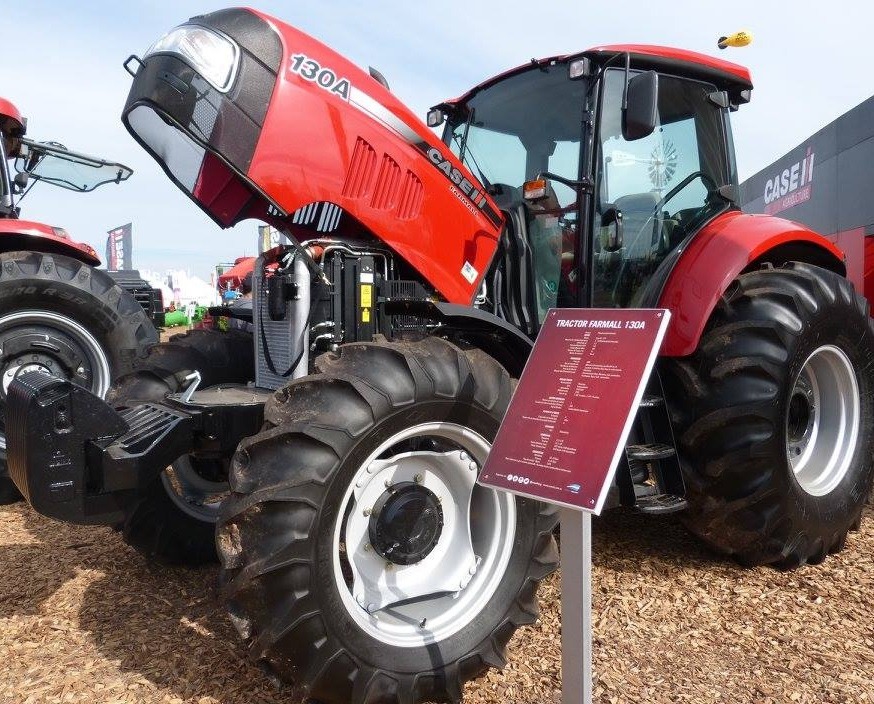
Case IH Farmall 75A (All-Around Round & Square Workhorse) 70.0 hp (62.0 certified PTO hp) Matches 4x4 and 4x5 variable chamber round balers Hydraulic flow: 12.5 gpm (47.3 lpm) 3-pt lift: 3,307 lb (1,500 kg) Commercial pasture haying, 4x5 round bales, disc mowing, and bale spear loading
John Deere 4020 (Heavy 5x6 Round Bale Standard) 95.0 hp (95.8 certified PTO hp) Matches large 5x6 commercial round balers and silage balers Hydraulic flow: 13.0 gpm (49.2 lpm) 3-pt lift: 3,950 lb (1,792 kg) Heavy silage round baling, multi-thousand bale commercial seasons, and steep hillsides

1. The Physics of Haymaking: PTO Torque vs Baler Plunger Inertia

Baling hay is one of the most physically demanding chores a tractor can perform. Unlike rotary cutting or field tillage where power demand is relatively continuous, a baler subjects the tractor drivetrain to violent, cyclical shock loads. On a small square baler, a heavy cast-iron flywheel spins at 500 RPM, driving a reciprocating steel plunger that slams into dry forage 60 to 90 times per minute. Each plunger stroke creates a sudden surge of resistance that rocks the tractor forward and backward. If a tractor lacks sufficient chassis weight, this violent plunger cycle causes extreme operator fatigue and destabilizes steering traction. On a round baler, power demand increases exponentially as the bale nears full density: the final 12 inches of bale formation consume more than 60% of total baling horsepower as hydraulic tensioners compress thousands of pounds of forage against spinning belts.

2. Small Square Baler Tractor Requirements (14x18 In Bales)

Small square balers (such as the New Holland 315, John Deere 348, or Massey Ferguson 1840 inline baler) are the foundation of equine and small livestock operations. While old sales literature often claimed that a 25-horsepower tractor could run a square baler, real-world field experience proves otherwise. Baseline requirements include: First, a minimum of 35 certified PTO horsepower for standard dry pasture hay, and 45 PTO horsepower if pulling a loaded hay wagon behind the baler or operating on sloping ground. Second, a bare tractor weight of at least 3,500 to 4,000 pounds; lightweight sub-compact tractors are pushed around dangerously by the baler plunger inertia. Third, an independent PTO clutch that allows the operator to stop tractor forward travel without stopping the baler flywheel.

3. Round Baler Sizing: 4x4 vs 4x5 vs 5x6 Bale Chambers

Round balers are categorized by bale diameter and width, and each step up in bale size demands substantially more tractor power. For 4x4 round balers (bales weighing 600 to 800 pounds), a 50 to 55 PTO horsepower tractor provides adequate capacity on level terrain. For 4x5 round balers (bales weighing 900 to 1,200 pounds, which is the most popular size for beef cattle operations), a tractor producing 65 to 75 PTO horsepower is required. For commercial 5x6 round balers (bales weighing 1,500 to 2,000 pounds) or round balers equipped with crop chopping knives for wet silage / baleage, a minimum of 85 to 100 PTO horsepower is mandatory. Attempting to roll a 5x6 bale with an undersized 50 hp tractor will cause the PTO clutch to slip, overheat, and glaze the friction plates.

4. PTO Types: Why Independent PTO Is Mandatory

Never attempt to bale hay with a tractor featuring a transmission-driven PTO (where the PTO stops rotating whenever the foot clutch is depressed). When baling a heavy windrow, thick clumps of hay frequently enter the baler pickup. With a transmission-driven PTO, stepping on the clutch to pause forward motion halts the baler mechanism immediately, packing the throat with uncompressed hay and shearing the flywheel shear pin. To bale successfully, you must have an Independent PTO (hydraulically engaged via an electric switch or hand lever) or a two-stage live clutch. An independent PTO allows the operator to stop forward ground travel instantly while the baler continues spinning at 540 RPM to swallow the slug of hay.

5. Hydraulic Remotes and Bale Handling Safety

Operating a modern round baler requires at least two sets of rear hydraulic remote valves: one circuit to raise and lower the baler pickup reel, and a second high-pressure circuit to open and close the heavy rear tailgate. In addition, once bales are formed and dropped in the field, moving them requires heavy equipment. A 4x5 round bale weighs roughly 1,000 pounds; a 5x6 bale weighs up to 2,000 pounds. To transport round bales safely with a front loader bale spear, the tractor must have a front loader lift rating exceeding 2,500 pounds and a three-point hitch rear counterweight to keep the rear steer axle firmly planted on slopes.

6. The Field Verdict: Matching Your Tractor to Your Hay Equipment

For hobby farmers producing 500 to 2,000 small square bales per year for horses, a heavy compact utility tractor like the Massey Ferguson 2850E (39 PTO HP, 3,869 lb) is the ideal agile match. For beef cattle producers rolling 300 to 1,000 round bales (4x4 or 4x5 size) annually, a mid-size utility tractor like the Case IH Farmall 75A (62 PTO HP, 7,350 lb) delivers the perfect balance of drawbar stability, fuel efficiency, and hydraulic performance. For commercial hay operations making thousands of dense 5x6 round bales or wrapping heavy high-moisture silage bales, a 90 to 120 horsepower heavy row-crop tractor like the John Deere 4020 or modern Deere 6M series provides the rugged, fatigue-free reliability required for non-stop summer harvesting.
checklist

Equipment Buyer's Verification Checklist

Pre-Haying Tractor Inspection Checklist

  • check_box_outline_blank Inspect tractor PTO shaft splines for twisting, scoring, or loose quick-release spring detent pins
  • check_box_outline_blank Check radiator cooling fins and removable screen for chaff accumulation; clean daily to prevent engine overheating
  • check_box_outline_blank Test rear hydraulic remote quick-couplers under full hydraulic pressure to verify zero seal leakage
  • check_box_outline_blank Verify engine fan belt tension to ensure full alternator output and water pump flow during 90-degree summer field days
  • check_box_outline_blank Check drawbar height: top of drawbar should sit exactly 14 to 16 inches above ground level for correct 540 RPM PTO shaft angle

help_outline Frequently Asked Questions

What is the minimum horsepower required to run a round baler?

A 4x4 round baler requires a minimum of 50 to 55 PTO horsepower. A 4x5 round baler requires 65 to 75 PTO horsepower. Large 5x6 commercial balers or balers equipped with silage cutter knives require 85 to 100+ PTO horsepower to achieve full bale density.

Can I run a small square baler with a 30 horsepower tractor?

A 30 gross horsepower tractor produces only 23 to 25 PTO horsepower. While it may spin an empty baler, it will severely bog down as soon as heavy hay enters the chamber. In addition, small tractors lack the 3,500-pound bare chassis weight needed to resist the rocking thrust of the baler plunger.

Why is an independent PTO necessary for hay baling?

An independent PTO allows you to stop the tractor forward movement without stopping the baler mechanism. If you hit a heavy slug of hay, you can stop the tractor, let the baler clear the wad at full 540 RPM speed, and then resume driving without shearing flywheel bolts.

How many hydraulic remotes are needed for a round baler?

Most modern round balers require two pairs of rear hydraulic remotes (four quick-coupler ports): one circuit to raise and lower the pickup head, and one circuit to open and close the rear discharge tailgate. Some economy balers can operate with one remote using a manual diverter valve.

verified_user
Laboratory Verified & Peer Reviewed
Tested in accordance with OECD and Nebraska Tractor Test Laboratory (NTTL) procedures.
Editorial Standards ↗
AP
Arthur Pendelton
Senior Agricultural Equipment Specialist

Specialist with All About Tractors, focusing on agricultural powertrain performance, implement geometry, and field test diagnostics. All specifications cross-referenced with certified manufacturer technical sheets.