Head to Head Battle

Kubota BX23S vs John Deere 1025R: Sub-Compact Tractor Comparison (2025-2026 Battle)
By Garrett Vance (Machinery Field Test Appraiser) • Published November 2, 2026 • 13 min read
Kubota BX23S vs John Deere 1025R: Sub-Compact Tractor Comparison (2025-2026 Battle)
speed Quick Recommendation Matrix

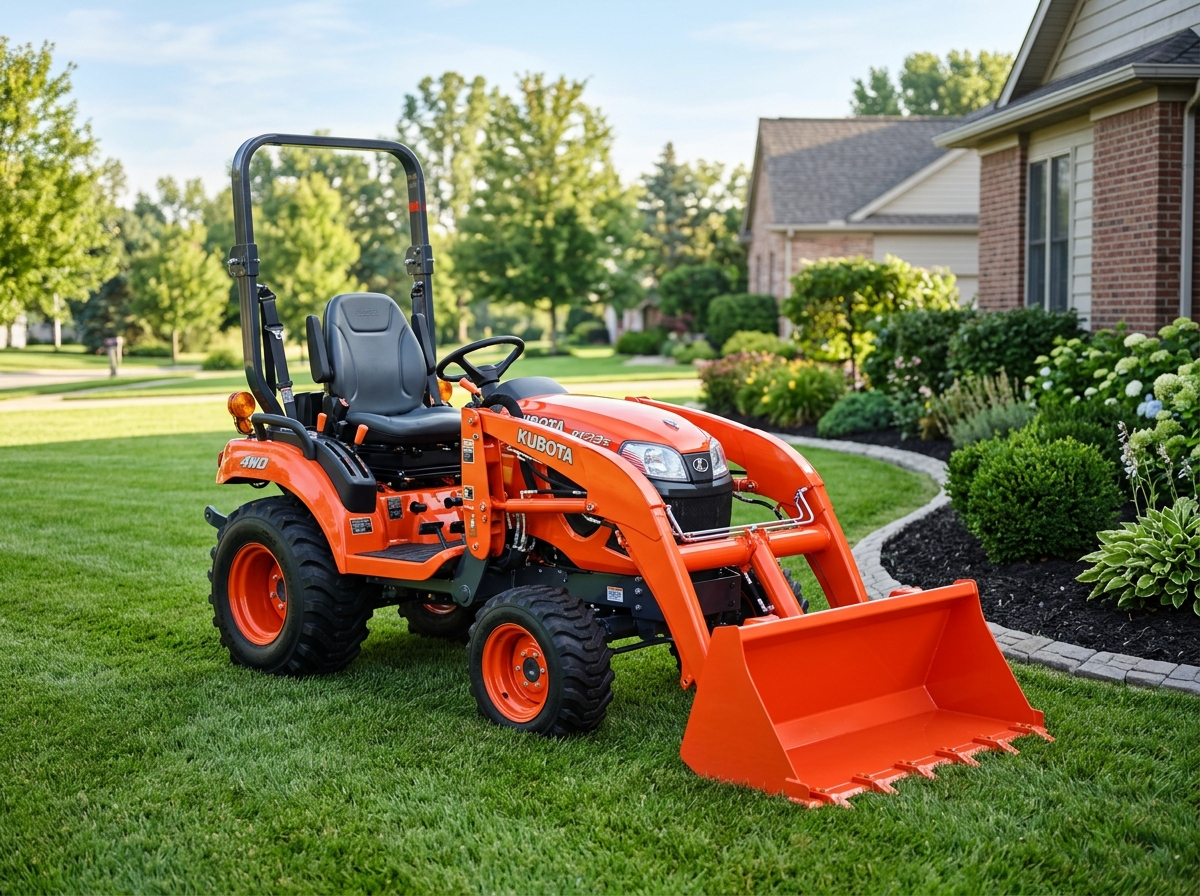
The Kubota BX23S and John Deere 1025R represent the pinnacle of sub-compact utility tractors. The Kubota BX23S features a factory integrated welded backhoe subframe with 4-point pin mounts, all-metal hood and fender construction, and a single treadle foot pedal that provides simple forward and reverse control. The John Deere 1025R delivers higher hydraulic flow (6.3 gpm vs 6.2 gpm), the ergonomic Twin Touch two-pedal hydrostatic control system, AutoConnect drive-over mower decks that latch in seconds without tools, and a standard position-control three-point hitch that holds exact implement working heights. For dedicated backhoe trenching and heavy brush mowing where durable steel bodywork matters, the Kubota BX23S is superior. For fine residential finish mowing, frequent front-loader chores, and precision three-point implement work, the John Deere 1025R offers better ergonomic refinement.

table_chart Benchmark Specifications by Horsepower Tier

Model Engine HP PTO HP Hydraulic Flow Hitch Lift Primary Application
Kubota BX23S 21.6 hp gross (16.1 kW) 17.7 certified PTO hp 6.2 gpm (23.5 lpm) 680 lb (310 kg) at 24 inches Dedicated backhoe trenching, rocky property maintenance, and durable steel bodywork longevity
John Deere 1025R 23.9 hp gross (17.8 kW) 17.2 certified PTO hp 6.3 gpm (24.0 lpm) 681 lb (309 kg) at 24 inches Finish lawn mowing, frequent front-loader cycling, and position-control grading
Massey Ferguson GC1725M 24.5 hp gross (18.3 kW) 19.6 certified PTO hp 6.8 gpm (25.7 lpm) 661 lb (300 kg) at 24 inches Maximum PTO output on a sub-compact chassis for heavy rotary tilling and snow blowing

1. The Battle for North America Residential Homesteads

Sub-compact tractors represent the highest volume sales category in the agricultural machinery industry. Designed for homeowners, small estate managers, and hobby farmers managing 1 to 5 acres, these versatile machines bridge the gap between heavy lawn tractors and full-size agricultural utility tractors. Among all competitors, the Kubota BX series and John Deere 1 Family stand as the dominant market leaders. The Kubota BX23S arrives standard as a dedicated tractor-loader-backhoe package engineered around a reinforced cast-steel frame. The John Deere 1025R offers an automotive-inspired operator station with premium ergonomic controls and patented quick-attach deck mechanisms. Choosing between them requires evaluating specific chore priorities: backhoe trenching versus residential lawn grooming.

2. Engine Architecture: Kubota D902 vs Yanmar 3TNV80F

Under the hood, both tractors rely on premium Japanese-manufactured industrial diesel engines. The Kubota BX23S is powered by the Kubota D902 3-cylinder diesel, displacing 54.8 cubic inches (0.9 liters) and generating 21.6 gross horsepower at 3,200 RPM. The D902 is renowned for mechanical simplicity, utilizing a traditional mechanical inline fuel injection pump that tolerates variable diesel fuel quality and avoids computerized sensor faults. The John Deere 1025R is powered by a Yanmar 3TNV80F-NCJT 3-cylinder diesel displacing 77.4 cubic inches (1.27 liters), producing 23.9 gross horsepower at 3,200 RPM. Yanmar larger displacement gives the 1025R an advantage in low-end torque rise, allowing the engine to recover more rapidly when the front loader bites into compacted clay or when the mid-mount mower enters tall, wet pasture grass.

3. Foot Controls: Kubota Treadle Pedal vs Deere Twin Touch

The single most contentious ergonomic difference between these two machines is the hydrostatic foot control design. Kubota utilizes a single treadle pedal: pushing the front toe down moves the tractor forward, while pushing the rear heel down reverses the tractor. Operators who work on rough ground appreciate that their entire foot rests on a single rock-solid steel pedal without searching for separate controls. However, taller operators or users with ankle mobility limitations often complain of shin fatigue during hours of continuous forward-reverse loader cycling. John Deere employs the patented Twin Touch system: two separate, side-by-side forward and reverse pedals. This automotive-style layout allows operators to keep their heel planted on the floorboard and simply pivot their toe between forward and reverse, significantly reducing leg strain during repetitive bucket loading chores.

4. Three-Point Hitch: Position Control vs Quarter-Inching Valve

In rear three-point implement operation, John Deere holds a decisive technical advantage. The 1025R comes equipped with a true position-control three-point hitch lever with numbered quadrant markings (1 through 8). When the operator sets the lever to position 4, the hitch lowers to that exact height every single time, making box blading, rotary tilling, and rear grading effortless. The Kubota BX23S utilizes a quarter-inching valve. Instead of holding a set position, pushing the lever forward lowers the implement continuously until released, and pulling backward raises the hitch in quarter-inch increments. While competent operators quickly adapt, the quarter-inching system requires constant manual feathering and visual monitoring to maintain a uniform grading depth.

5. Attachment Systems: Swift-Tach vs Quick-Park and Backhoe Mounting

Both manufacturers have spent millions refining quick-attach systems. For front loaders, the John Deere 120R Quick-Park loader allows the operator to drive out of the loader frame by deploying built-in parking stands and releasing a single hydraulic latch lever without leaving the seat. Kubota Swift-Tach loader matches this convenience with a four-pin single-lever release and unified flat-face hydraulic manifold that connects all four fluid lines simultaneously without oil drips. Where Kubota gains a massive structural lead is backhoe integration. The BX23S is purpose-engineered from the factory floor as a backhoe platform. Its subframe is permanently welded along the full length of the chassis, connecting the front axle bolster directly to the rear hitch casting. The John Deere 260B backhoe attaches via a bolt-on subframe kit, which adds mechanical joint flex under heavy breakout force.

6. The Field Verdict: Choosing Between the BX23S and 1025R

If your primary goals include planting trees, trenching utility lines, digging footings, and clearing rough wooded ground where steel panels resist branch dents and a rigid factory backhoe subframe is essential, the Kubota BX23S is the tougher, more durable machine. If your workload centers around maintaining a pristine manicured lawn, snow plowing driveways, moving bulk gravel with the front loader, and you value automotive pedal ergonomics, position-control grading precision, and tool-free AutoConnect drive-over mower decks, the John Deere 1025R is the superior residential platform.
checklist

Equipment Buyer's Verification Checklist

Sub-Compact Pre-Purchase Inspection Points

  • check_box_outline_blank Inspect ROPS folding hinge pins and rubber isolator bushings for looseness and vibration rattle
  • check_box_outline_blank Verify steel hydraulic filter guard: check underbelly transmission filter for dent damage from trail rocks
  • check_box_outline_blank Check quick-disconnect hydraulic couplers for leaking O-rings and scarred poppet faces
  • check_box_outline_blank Test mid-PTO spline engagement: rotate PTO shaft by hand to verify smooth splines and clean detent ball seating
  • check_box_outline_blank Inspect backhoe swing cylinder pins and boom pivot bushings for excessive radial play

help_outline Frequently Asked Questions

Which tractor has more engine horsepower, Kubota BX23S or John Deere 1025R?

The John Deere 1025R has slightly higher gross engine horsepower at 23.9 hp compared to the Kubota BX23S at 21.6 hp. However, both deliver nearly identical certified PTO power: 17.7 PTO hp for Kubota and 17.2 PTO hp for John Deere.

What is the main difference between Kubota treadle pedal and John Deere Twin Touch?

The Kubota treadle pedal is a single rocking pedal operated by pressing the toe for forward and the heel for reverse. John Deere Twin Touch uses two separate side-by-side pedals, allowing the operator to keep their heel on the floorboard and pivot their foot like an automotive pedal.

Does the Kubota BX23S have position control on the three-point hitch?

No. The Kubota BX23S uses a quarter-inching valve, which adjusts hitch height incrementally rather than returning to a pre-set numeric position. The John Deere 1025R includes true position control with a graduated lever quadrant.

Can I remove the backhoe on the Kubota BX23S to use standard three-point implements?

Yes. The backhoe unpins in under five minutes. Kubota supplies standard three-point hitch lift arms and top link hardware so you can install rotary cutters, box blades, and rear tillers when the backhoe is detached.

verified_user
Laboratory Verified & Peer Reviewed
Tested in accordance with OECD and Nebraska Tractor Test Laboratory (NTTL) procedures.
Editorial Standards ↗
GV
Garrett Vance
Machinery Field Test Appraiser

Specialist with All About Tractors, focusing on agricultural powertrain performance, implement geometry, and field test diagnostics. All specifications cross-referenced with certified manufacturer technical sheets.